


 Toute l'actualité
In recent years, the Science Based Targets initiative (SBTi) has established itself as the leading framework for corporate climate strategies. More than 10,400 companies across over 100 countries and 50 sectors have already committed to this approach, which is aligned with the latest findings of the IPCC’s Sixth Assessment Report (AR6) and the Paris Agreement’s goal of limiting global warming to 1.5°C.
The SBTi Corporate Net-Zero Standard (CNZS) enables organizations to define a carbon emissions reduction pathway across their entire value chain (Scopes 1, 2 and often 3) by setting near-term and long-term targets, allowing them to reach net zero by 2050.
While the SBTi places strong emphasis on emissions reductions, it has never limited corporate climate action to this single lever. From the outset, it has also recognized the importance of mobilizing finance for climate mitigation beyond companies’ value chains. Even with ambitious reductions, the transition to global net zero will require a large-scale deployment of emission avoidance and carbon removal solutions, including Nature-based Solutions (NbS), as highlighted by the United Nations Environment Programme (UNEP).
BVCM: Climate contribution at the core of SBTi recommendations
One of the most frequently misunderstood aspects of the SBTi framework concerns the role and implementation of climate contribution mechanisms beyond companies’ value chains. Yet since the publication of the Corporate Net-Zero Standard in 2021, the initiative has actively encouraged companies to take such action through the Beyond Value Chain Mitigation (BVCM) framework.
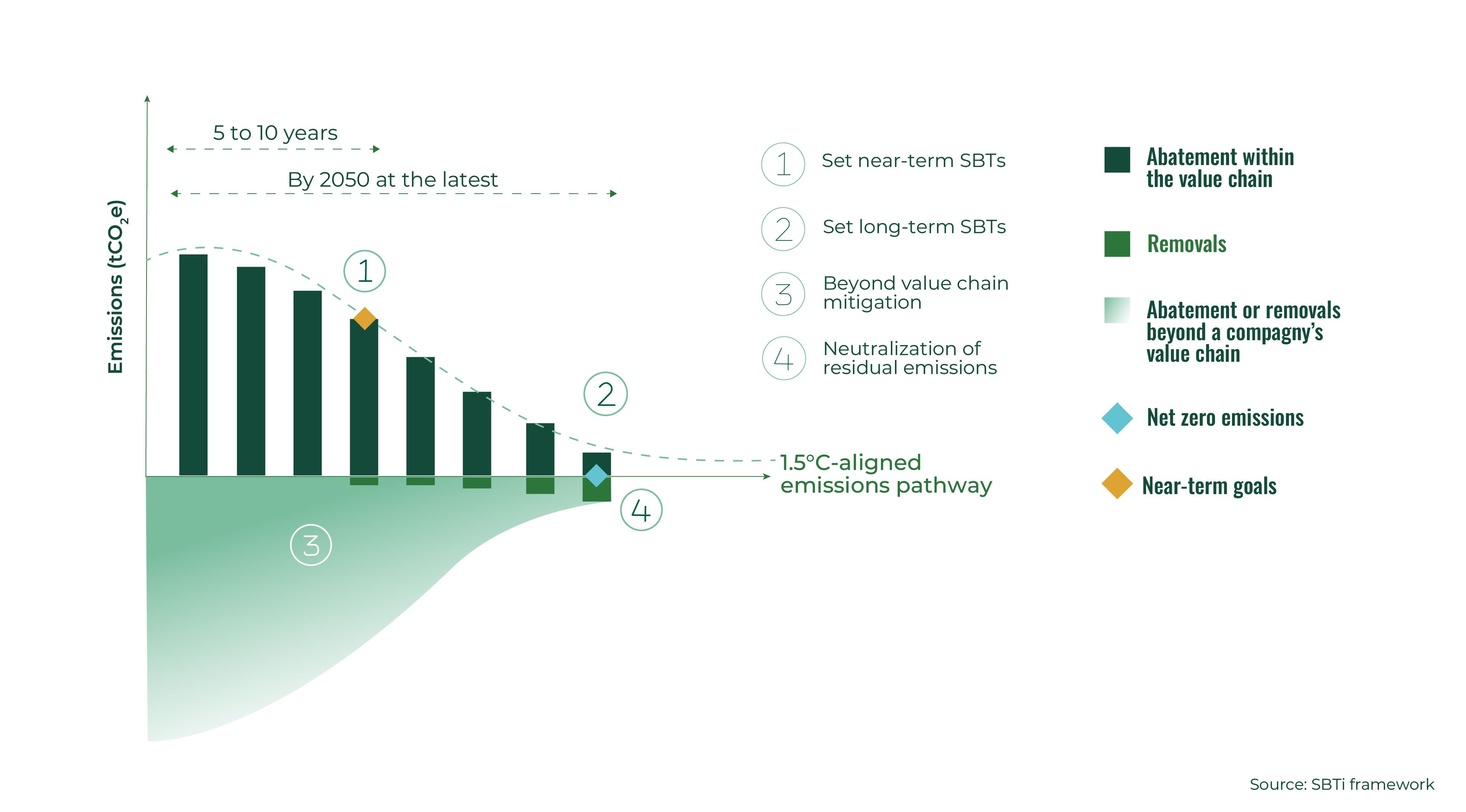
The BVCM framework promoted by the SBTi
BVCM refers to a company financing climate mitigation activities outside its value chain, while simultaneously implementing its validated emissions reduction pathway. This includes supporting projects that avoid emissions as well as projects that remove carbon from the atmosphere. Within this approach, Nature-based Solutions are highlighted by the SBTi as essential tools for climate change mitigation.
A virtuous complement to emissions reduction targets
This mechanism is commonly referred to as carbon contribution. Its objective is straightforward: accelerate global climate action by channeling greater private finance toward high-impact – and often underfunded – climate solutions, while enabling companies to contribute to the UN Sustainable Development Goals (SDGs).
The SBTi also emphasizes that this approach brings strategic benefits for companies. Over time, it helps accelerate the global transition to net zero, defined as reducing 90 to 95% of a company’s emissions by 2050, combined with the full neutralization of residual emissions, notably through carbon removal projects.
Strategic climate finance can also help companies mitigate climate-related risks while strengthening their long-term financial resilience and value creation.
A voluntary yet evolving framework
At this stage, the BVCM framework remains voluntary and is not subject to formal validation by the SBTi. However, the initiative encourages companies to structure their approach by:
- defining a clear beyond-value-chain commitment framework (objectives, timeline and scope)
- supporting projects that meet key environmental integrity criteria (additionality, permanence, and avoidance of double counting)
- prioritizing third-party verified projects based on standardized methodologies
- establishing measurement, reporting and verification (MRV) systems
- communicating transparently on supported projects and achieved impacts
The SBTi also encourages ambitious levels of engagement—for example, by supporting mitigation activities delivering emission reductions or removals equivalent to at least 50% of a company’s unabated emissions.
OER: Toward greater corporate climate responsibility
The revision of the Corporate Net-Zero Standard, with a draft published in November 2025, suggests that beyond-value-chain climate contributions are likely to play an increasingly significant role. In this updated version of the standard, the SBTi introduces a more structured framework: Ongoing Emissions Responsibility (OER).
From voluntary contribution to climate responsibility
While BVCM encouraged voluntary contributions, the proposed OER framework introduces a more structured approach. Companies are invited to take explicit responsibility for the emissions they continue to generate during their transition to net zero. This mechanism creates a clearer link between companies’ historical and ongoing emissions and their contribution to addressing the global climate crisis. The objective is to embed carbon contribution more firmly within corporate climate and financial strategies.
Quantified targets and recognition mechanisms
Although the draft standard is currently being reviewed by the SBTi, it introduces several key developments:
recognition of corporate engagement through two levels (“recognized” and “leadership”) designed to promote reputational incentives
quantified contribution targets, expressed either in tCO₂e (Mitigation Impact Contributions) or financial contributions per tCO₂e (Climate Finance Contributions), enabling clearer comparison of commitments
strong encouragement to integrate climate contribution into corporate climate strategies, notably through the implementation of an internal carbon price, and the possibility that the framework could become mandatory for certain companies by 2035
a preference for measurable and verified climate impacts, often through certified carbon credits, although other projects may be accepted if they demonstrate credible and verifiable climate benefits
However, one fundamental principle remains unchanged as companies approach 2050: in order to achieve net zero, they must fully neutralize 100% of their residual emissions.
The direction proposed in the Draft Corporate Net-Zero Standard V2.0 sends a strong signal to companies: contributing beyond their value chain is no longer merely a complementary action, but rather a strategic climate solution to be deployed alongside emissions reduction efforts.
Whether through the BVCM framework – already in place – or the currently under review Ongoing Emissions Responsibility (OER) framework, these mechanisms share a common objective: accelerating climate action today rather than waiting until the net-zero target year to mobilize the necessary solutions.
In this context, financing carbon projects is increasingly emerging as a meaningful pathway to support a company’s SBTi trajectory, alongside the strict emissions reduction pathways implemented within its value chain.
Nature-based Solutions to support SBTi climate contribution strategies
Nature-based Solutions (NbS) are particularly well suited to building high-integrity climate contribution strategies. In addition to enabling carbon storage – with forests representing the largest terrestrial carbon sink – they deliver essential co-benefits for biodiversity, soil health, water systems and local communities. Investing in NbS therefore allows companies to align climate strategy with broader ESG objectives, moving beyond a purely carbon-centric approach.
Anticipating near-term SBTi targets
To date, more than 10,000 companies have committed to the SBTi with near-term targets covering a 5- to 10-year timeframe, many of which converge around 2030. In this context, climate contribution represents an actionable lever that companies can activate today to maximize their climate impact under the BVCM framework while continuing to implement emissions reduction pathways.
At the same time, new quality standards and integrity frameworks are emerging in the voluntary carbon market, contributing to a more robust ecosystem for climate projects. Despite these improvements, the supply of high-integrity projects remains limited, largely due to chronic underfunding. As a result, it is becoming strategically important for companies to secure their climate contribution commitments early.
With this in mind, Reforest’Action develops Nature-based Solutions, particularly through forest ecosystem projects, to support companies in achieving their 2030 climate objectives.
A portfolio of solutions tailored to corporate needs
With over 15 years of experience in Nature-based Solutions, Reforest’Action offers a range of solutions designed to help companies secure climate contributions beyond their value chains. Through a diversified set of projects - including forest restoration, agroforestry and tropical forest conservation initiatives - certified or verified by recognized third parties and spanning different geographies and pricing levels, companies can build carbon project portfolios aligned with their operational constraints and climate objectives.
The carbon units generated by our projects are available for immediate mobilization and can therefore be integrated into short-term SBTi strategies:
REDD+ carbone credits: Carbon credits certified under recognized standards (VCS, CCB) generated by projects that protect tropical forests threatened by deforestation or forest degradation. These projects contribute to biodiversity conservation while supporting sustainable economic opportunities for local communities.
Label bas-carbone credits: Forestry projects developed by Reforest’Action and certified under France’s Label Bas-Carbone, contributing to the (re)forestation of French forests. The Label Bas-Carbone currently represents the only official certification framework for quantifying nature-based carbon removal in France, supporting the French National Low-Carbon Strategy (SNBC).
Carbon units from verified projects: (Agro)forestry projects developed by Reforest’Action with 30-year carbon sequestration projections validated by Bureau Veritas, combined with an independent field audit after five years, ensuring transparency and environmental integrity.
As the SBTi evolves from voluntary climate contribution toward a more structured approach to corporate climate responsibility, beyond-value-chain contributions are becoming increasingly central to corporate climate strategies.
For companies, acting beyond the value chain does not mean acting in isolation from their core business. On the contrary, high-integrity climate action can be anchored locally, closely connected to territories, ecosystems and corporate stakeholders.
In this context, Nature-based Solutions offer a concrete opportunity to support companies in achieving their near-term SBTi targets while generating positive environmental and social impacts where they matter most.
Discover how Reforest’Action’s solutions can support your climate strategy.
Note: Activities and investments related to BVCM and OER frameworks are not accounted for within Scope 1, 2 or 3 emissions and do not contribute to value-chain emissions reduction targets. They therefore cannot replace corporate decarbonization efforts.