


 Toute l'actualité
FAO’s The State of the World’s Forests 2026 underscores the scale of the challenge: 460 million hectares of forests and other wooded land are degraded. Funding for restoration remains below a quarter of estimated annual needs. Increasing these financial flows is essential. Equally important is ensuring that they support the long-term recovery of ecological functions.
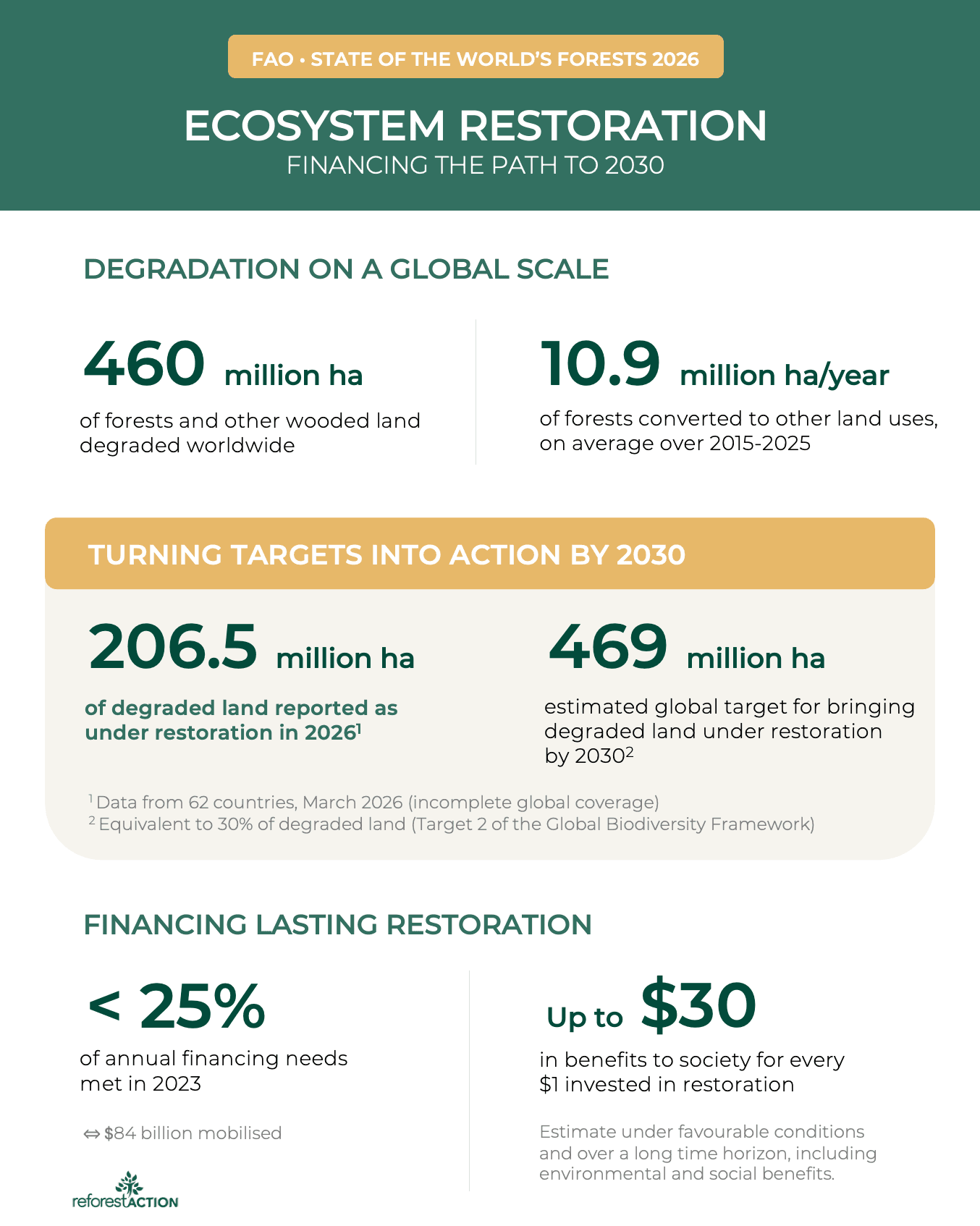
The fundamental question is which functions need to be restored, and how to sustain them in a changing climate. Re-establishing vegetation cover alone does not demonstrate that an ecosystem has regained its ecological functions. Its capacity to regulate water, support biodiversity and regenerate over time must also be assessed. The number of hectares is a useful indicator of the scale of action; on its own, it tells us little about the quality of restoration.
At Reforest’Action, we believe this quality must be built into a project from the outset. It requires an understanding of the landscape’s ecological needs, land uses and local communities’ expectations. It also requires anticipating climate change: ecosystems restored today will need to function under different temperature and rainfall patterns.
This perspective has direct implications for project financing. Restoration requires upfront capital, alongside resources to maintain, monitor and adapt interventions over time. Its economic model must account for this time horizon and for the conditions that enable local stakeholders to sustain their involvement.
Carbon credits can help structure financing for projects whose climate benefits can be quantified and certified. Direct contributions to Nature-based Solutions can also support restoration needs, including those related to water and biodiversity, for which carbon certification may not provide a viable funding model. The suitability of financing should be assessed against its ability to meet the project’s needs and sustain its outcomes over time.
The next phase of global restoration must bring together three requirements: more funding, locally grounded project design and evidence of outcomes. For Reforest’Action, resilience must become a core criterion in financing decisions, from project design through implementation.