

Marlenheim - France
Urban forest
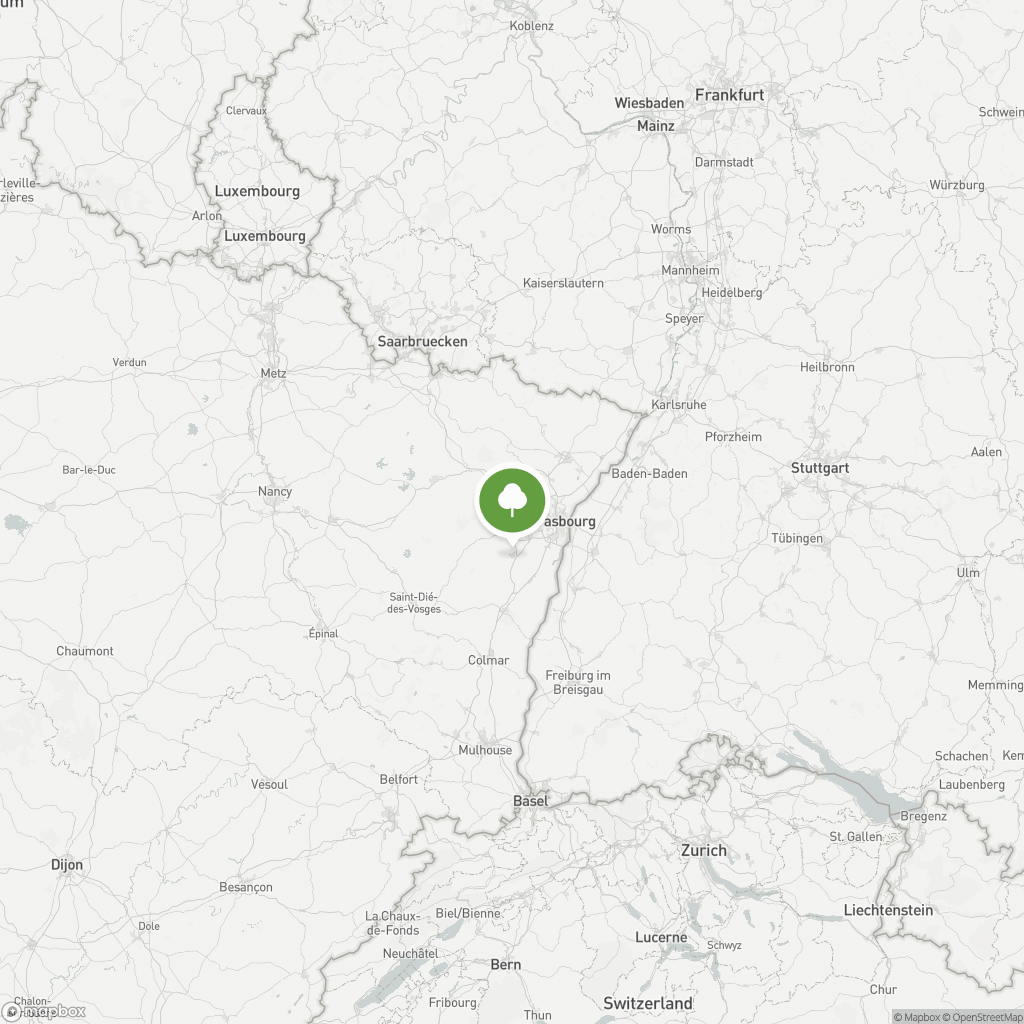
Located in Marlenheim, the land to be reforested is close to a former stork park with hedges and small wooded areas following a river, the Mossig, creating an ecological continuity with the Wangenberg forest.
 2023 - 2024
 Financé




Along with the Haut-Rhin, this département is the historic region of Alsace, whose emblem is the famous white stork, which was said to bring newborn babies clutched in a white cloth that it carried by the tray. The bird, which once disappeared from the region, is now protected and of "minor concern" according to the IUCN.
In the field, we carry out an initial soil analysis of the area to be afforested, which enables us to identify 15 to 30 tree species native to the region. The plants corresponding to the selected species are then raised in nurseries.
Our technical network on the ground prepares the soil. Mounds of loose earth can be created on the plot to regulate rainwater run-off. Wood shavings and decomposed vegetation, which provide the soil with nutrients, are placed in the planting area.
The trees are planted very densely and randomly: 3 to 5 young shoots per m2. This technique makes it possible to reproduce the complexity of a natural environment, where species emulate each other and cooperate. Straw bales are then placed around the trees to protect them.
Maintenance and monitoring is carried out by our technical network over a 2-year period. Plant recovery is often over 90% in the first year. Young trees double in size in the first year. After 2 years, the forest becomes entirely self-sufficient and no longer requires any maintenance. A closed canopy is formed in 5 years, and a mature forest in 20 years.